

On November 27, 2025, I attended the "Data & AI Summit '25 Fall" hosted by Google.
Recently, our company decided to seriously tackle "data utilization" and quietly launched a project. At first, we were working on it slowly, starting with what we could do, but one day we heard that Google was hosting the "Data & AI Summit '25 Fall."
I decided to attend the event without much thought, thinking, "I need to keep up with the latest trends in data utilization!", but it was a great decision. I heard a lot more interesting talks than I expected.
Data & AI Summit '25 Fallとは?
As you can probably guess from the event name, the topic of this talk was "AI Agents." It was a hybrid event, with approximately 3,000 attendees, making it a huge success. I attended in person, and there were lines for some talks, and some people had to stand due to a lack of seats. I got a real sense of the high level of interest in data utilization and AI.
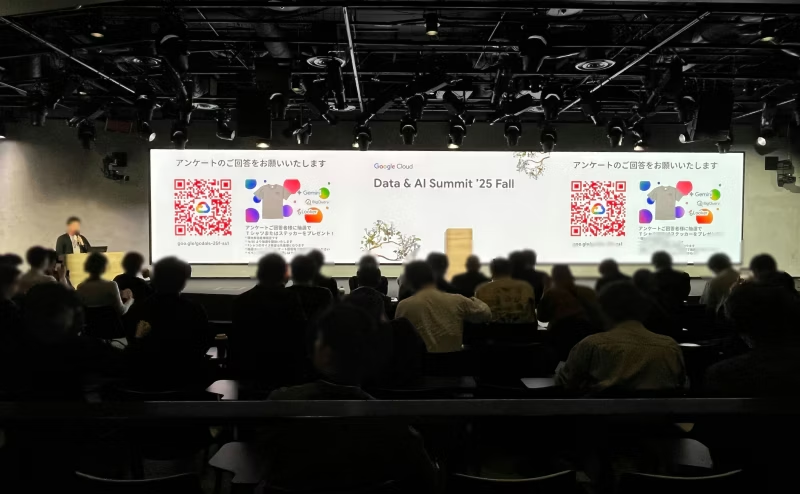
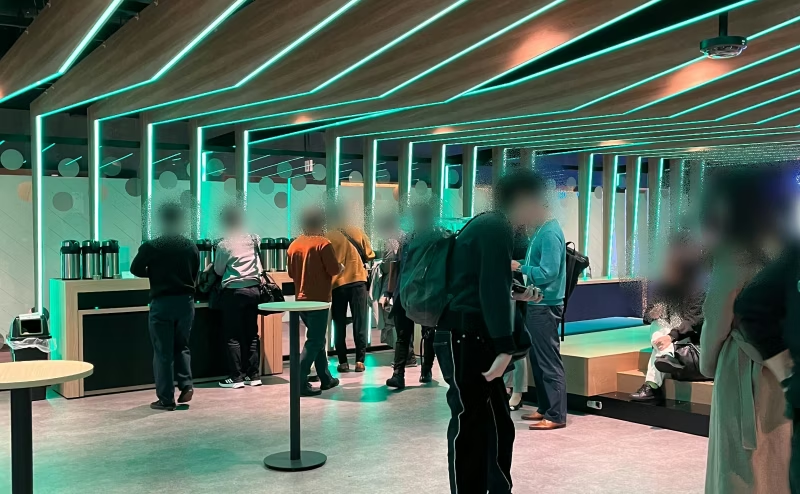
The timetable for the day looks like this.
https://cloudonair.withgoogle.com/events/data-ai-summit-25f
In this article, we will report on the keynote speech and particularly memorable sessions!
Keynote speech: Towards an era of "co-creation" with data agents - Next-generation data analysis with an AI-Ready data infrastructure
The keynote speech consisted of three parts: "Three requirements for AI agents" by Hamada from Google Cloud, followed by examples of data utilization by Lion Corporation and Mercari, Inc., and a "demo of conversational analytics" by Google's technology division.
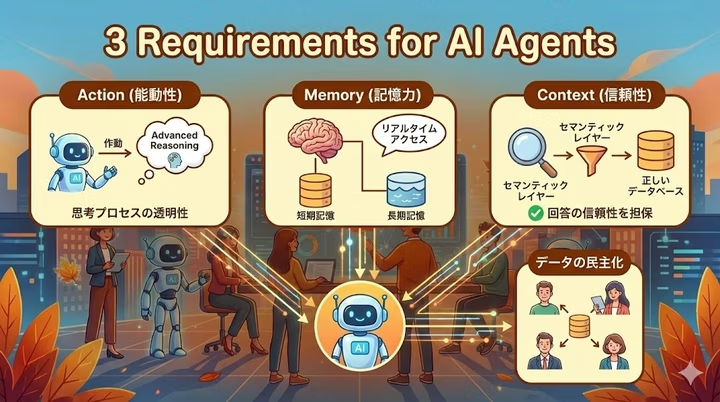
◼︎Three requirements for AI agents
Hamada gave a presentation on the three essential requirements for fully introducing AI agents and having them handle business operations: "Action," "Memory," and "Context."
Action: AI agents should take action proactively, not passively.
The key here is "transparency of the thought process." He explained that the concept of "Advanced Reasoning," which divides a series of steps into stages, is key to improving the transparency of analysis.
Memory: "Short-term memory" and "long-term memory" required for an AI agent to function effectively.
In an explanation of "long-term memory," which allows real-time access to data held by companies, an example was given of someone communicating with an AI agent by voice command to order a product. This was much faster than the traditional tap-based operation, and it reaffirmed to me how much more familiar it has become.
Context: Context is essential to ensure the reliability of answers.
The importance of the "semantic layer" in guiding to the correct database and calculation formula was explained.
I had many opportunities to hear about the semantic layer in subsequent lectures, and I realized that it is gaining more and more attention.
◼︎Examples of data utilization
Lion Corporation gave a presentation on building a data infrastructure, and Mercari Inc. introduced its efforts towards democratizing data.
The democratization of data in particular left a strong impression on me, as it is something that is close to home to me. The introduction of AI agents has made it possible for anyone to access data, something that was previously the domain of analysts, and this is something that our company would like to emulate.
At a sharing session held within the company later, we talked about how we wanted to implement this idea immediately.
◼︎Conversational analytics demo released
A demo of a conversational analytics agent was presented using "Conversation analytics agent in BigQuery" as an example.
Although I've had some experience with BigQuery, I had no idea it was possible to analyze data using natural language, so it was a real eye-opener. The support is excellent, with Gemini's suggestions for improving data accuracy and automatically generating golden queries, and I was impressed by how relatively easy it was to set up.
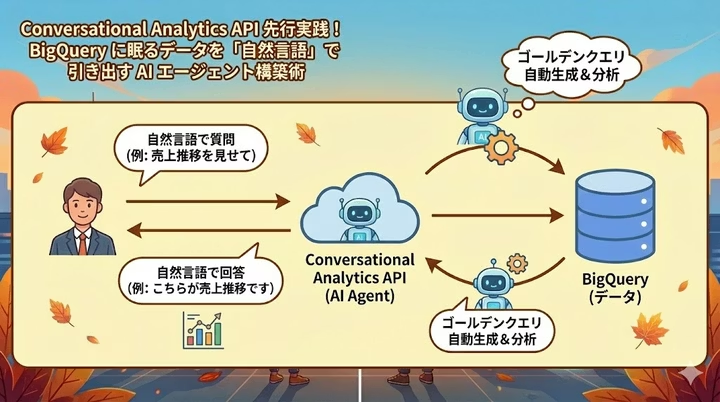
Conversational Analytics API Preliminary Practice! How to Build an AI Agent that Extracts Data from BigQuery Using Natural Language
In a presentation by Irete Inc., they introduced a case study of data analysis in chat format, combining "Big Query" and "Conversational Analytics API."
The idea was to store site data in BigQuery and then outsource all query execution and analysis to the Conversational Analytics API. By making the AI agent accessible from everyday communication tools, an environment was created where anyone could easily utilize the data.
The content truly embodied the "democratization of data" that was discussed in the keynote speech, and the structure was very simple. I immediately wanted to incorporate it into my company.
I would love to implement it myself, but considering the practical skills required, it would probably take years, so I'll leave it to our engineers!
Minimal steps! Collaboration between Google Trends-linked AI agent and product master
In a lecture by AEON Smart Technology Co., Ltd., they introduced how they are using AI for "product master data," an initiative unique to a company with physical stores.
The presentations focused on two challenges: "Resolving fuzzy searches" and "Automatic trend matching." Both presentations utilized Google Vertex AI Search.
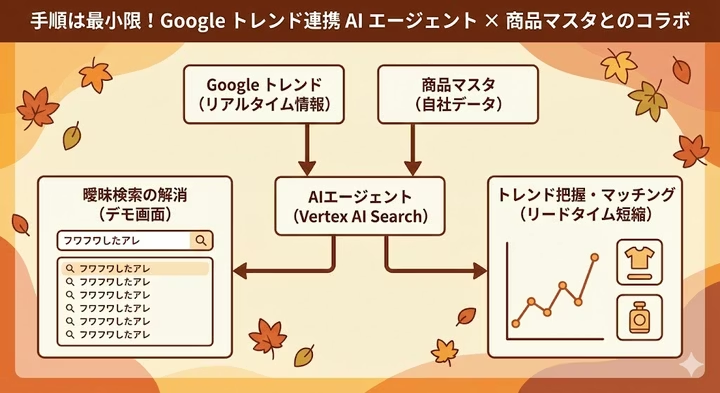
— Fuzzy search using AI in product master data
He spoke about the issue of customers asking vague questions without specific product names, a problem unique to companies with physical stores. Conventional systems require an "exact match," so questions that are easy for humans to answer become a major hurdle for the system. This is an initiative to try an AI approach to address this issue.
The demo screen showed a system that instantly outputs relevant product information from big data, even for vague input such as an internet search. I didn't really understand how it worked, but I was simply impressed that a company could do this much.
— Trend detection and automatic matching with product data
They explained that they are considering a tool that can instantly capture external trend information and automatically link it with their own product data, with the aim of shortening the lead time between when a customer need arises and when the product actually appears in stores.
This was also a talk about cutting-edge technology, and it was very interesting. I can't yet imagine how it can be used in our company's services, but I would like to personally try out "Google Vertex AI Search."
summary
We've picked out and introduced only the most memorable sessions, but what did you think? We hope we were able to share even a little of the excitement we felt at the "innovation brought about by data agents" that day.
To be honest, we had been making slow progress in terms of data utilization, but participating in this summit was a great opportunity to remind ourselves that we need to get serious about it so we don't get left behind.
First, I would like to start with the definition of the data and semantic layer, the importance of which has been emphasized many times this time.


Currently working hard as a director, having joined the company as a new graduate! He challenges himself every day with the aim of becoming a multi-talented person who can master all fields, from design to advertising management. While he strives for smart direction at work, in his private life he enjoys the reclusive life in the fortress he calls his home. He also loves anime.
Handa
Web Director / Joined in 2022