

On November 27, 2025, we participated in Google's "Data & AI Summit '25 Fall."
Our company recently made the decision to seriously tackle "data utilization," and a project quietly got underway. We started with a relaxed approach, figuring we'd begin with what we could handle, but then we heard that Google was hosting "Data & AI Summit '25 Fall."
Thinking "we need to stay on top of the latest trends in data utilization," we decided to attend on a whim—and it turned out to be the right call. We heard far more valuable insights than we expected.
What is Data & AI Summit '25 Fall?
As you can probably guess from the event name, the main theme was "AI agents." It was held in a hybrid format with approximately 3,000 participants—a huge success. I attended in person, and at some sessions there were lines forming, with standing room only when seating ran out. I could really feel how much attention data utilization and AI are receiving.
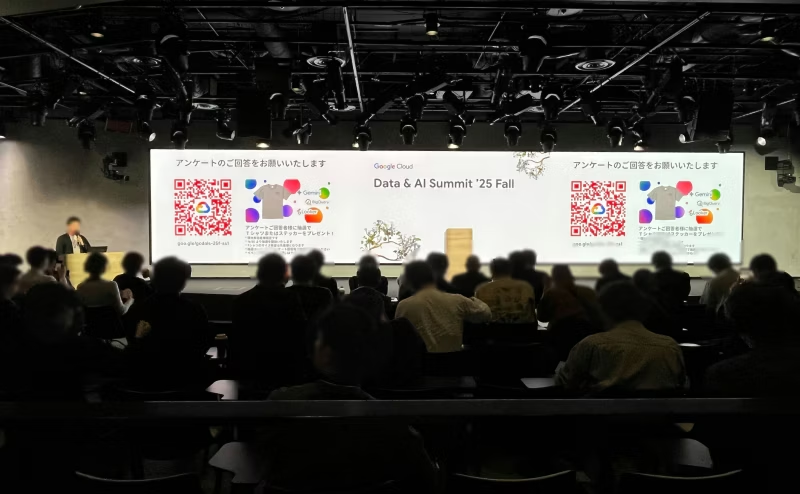
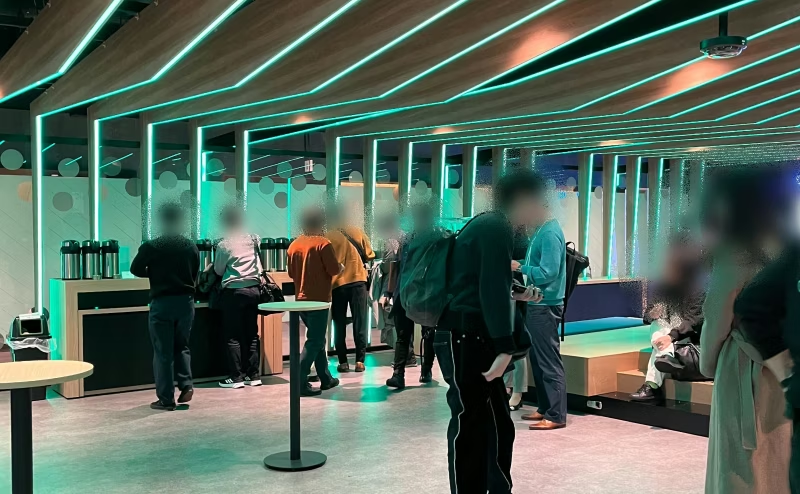
Here's what the day's schedule looked like.
https://cloudonair.withgoogle.com/events/data-ai-summit-25f
In this article, we report on the keynote and the sessions that left a lasting impression!
Keynote: Co-creating with Data Agents - Next-generation Data Analysis through AI-Ready Data Infrastructure
The keynote featured three segments: "Three Requirements for AI Agents" by Hamada from Google Cloud, case studies of data utilization from Lion Corporation and Mercari, and a public demo of "Conversational Analytics" by Google's technology division.
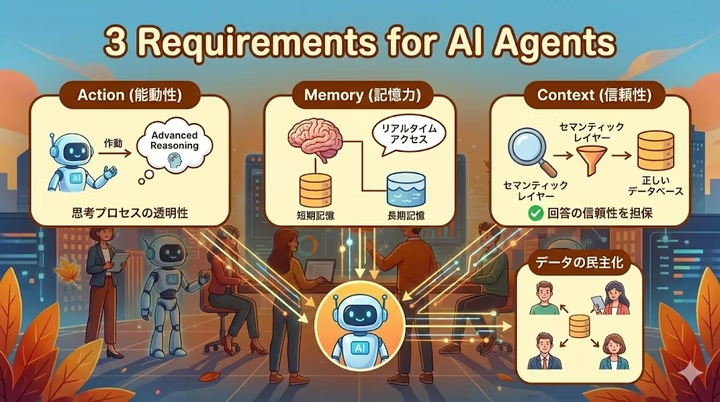
■ Three Requirements for AI Agents
Hamada presented on three essential requirements for fully deploying AI agents to handle business operations: "Action" (initiative), "Memory" (retention), and "Context" (reliability).
Action: AI agents should take proactive action rather than be passive.
What becomes critical here is "transparency in the thinking process." To improve analytical transparency, the concept of "Advanced Reasoning"—breaking down a series of flows into sequential steps—is key.
Memory: "Short-term" and "long-term" memory for AI agents to function effectively.
In the explanation of "long-term memory"—real-time access to corporate data—a use case was presented where users communicate with an AI agent via voice input and place product orders. It was remarkably faster than traditional tap-based interactions, and it reinforced how much a reality AI agents have already become in our daily lives.
Context: Context is essential to ensure the reliability of responses.
There was an explanation of the importance of a "semantic layer" to guide toward the correct database and formulas.
Regarding the semantic layer, I noticed it came up frequently in subsequent presentations, and the level of attention it's receiving continues to grow.
■ Data utilization case studies
Lion Corporation presented on data infrastructure development, and Mercari Inc. introduced their initiatives toward data democratization.
The topic of data democratization particularly stood out, as it felt relevant to our own work. Through AI agent deployment, the approach to making data accessible to everyone—rather than limiting data utilization to analysts—is something our company should learn from.
In an internal knowledge-sharing session we held later, there was already discussion about implementing these ideas.
■ Conversational analytics demo showcase
A demo of a conversational analytics agent was introduced, using "Conversation analytics agent in BigQuery" as an example.
While I've only touched BigQuery briefly, I was surprised to learn that natural language data analysis is now possible. I was genuinely impressed by the robust support features—such as improved data accuracy through Gemini recommendations and automatic golden query generation—and how relatively straightforward the setup is.
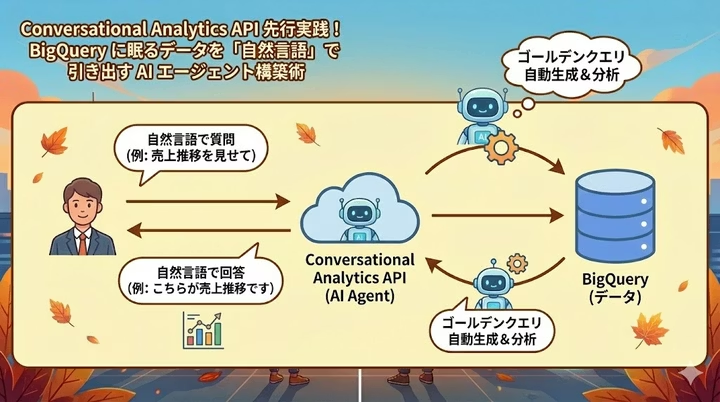
Get ahead with Conversational Analytics API: Building an AI agent that extracts hidden BigQuery data using natural language
Ailett Corporation presented a case study combining BigQuery and Conversational Analytics API for chat-based data analysis.
The approach involves storing site data in BigQuery and delegating query execution and analysis tasks to Conversational Analytics API. By making the AI agent accessible directly from everyday communication tools, they've created an environment where anyone can easily leverage data.
This perfectly embodies the "democratization of data" discussed in the keynote, with a remarkably simple architecture. We immediately saw the value in adopting this approach.
While I'd love to implement this myself, given realistic skill constraints it would take years. So I'm planning to leave this in the hands of our engineering team!
Minimal setup required: AI agent integrated with Google Trends and product master data
Aeon Smart Technology Corporation presented how they leverage AI for product master data—a uniquely valuable perspective from a company operating physical retail locations.
The presentation addressed two key challenges: resolving ambiguous searches and automatically matching trends. Both solutions utilized Google Vertex AI Search.
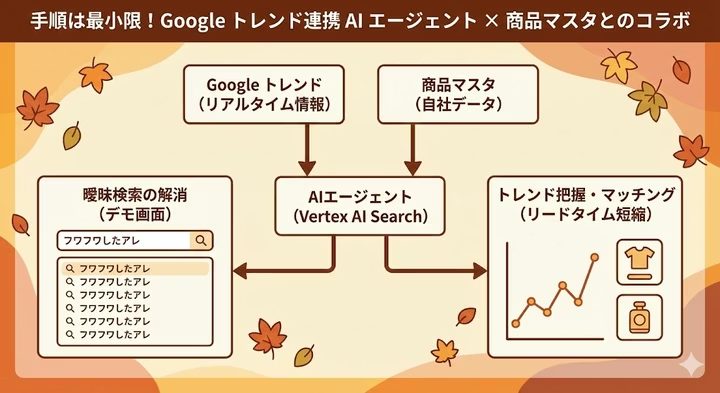
— Handling ambiguous product master searches with AI
They highlighted a pain point unique to brick-and-mortar retailers: vague customer inquiries without specific product names. Traditional systems demand exact matches, turning questions humans answer effortlessly into system roadblocks. Their response was to apply an AI-driven approach to this challenge.
In the demo, we saw a system that could output appropriate product information from big data instantly, even in response to vague input like an internet search. I didn't fully understand the mechanism, but I was simply impressed—the fact that a single company could achieve this level of capability.
— Automatic matching of trend insights with product data
The goal is to shorten the lead time from when customer needs emerge to when products actually appear on shelves. To achieve this, they are exploring a tool that immediately captures external trend information and automatically links it to their own product data.
This was another fascinating presentation on cutting-edge technology. While I haven't yet envisioned how to apply it to our services, I'm personally interested in trying out Google Vertex AI Search.
Summary
I've highlighted only the sessions that left a strong impression, but did you find this overview helpful? I'd be delighted if I could share even a little of the inspiration I felt from the "Innovation Brought by Data Agents" theme at the event.
To be honest, we've been moving forward at a leisurely pace with data utilization. But participating in this summit was an excellent opportunity—it reminded me that we need to take action now so we don't get left behind by this wave of change.
I plan to start with "defining data and semantic layers"—something emphasized repeatedly at the summit for its importance.



A self-made director since joining as a new graduate, currently thriving in my role! I'm pursuing the goal of becoming a multi-talented professional who can master every field, from design to ad operations. At work, I aim for smart direction, while in my private life I enjoy a reclusive fortress of a home. I happen to like anime.
Handa
Web Director / Joined 2022