
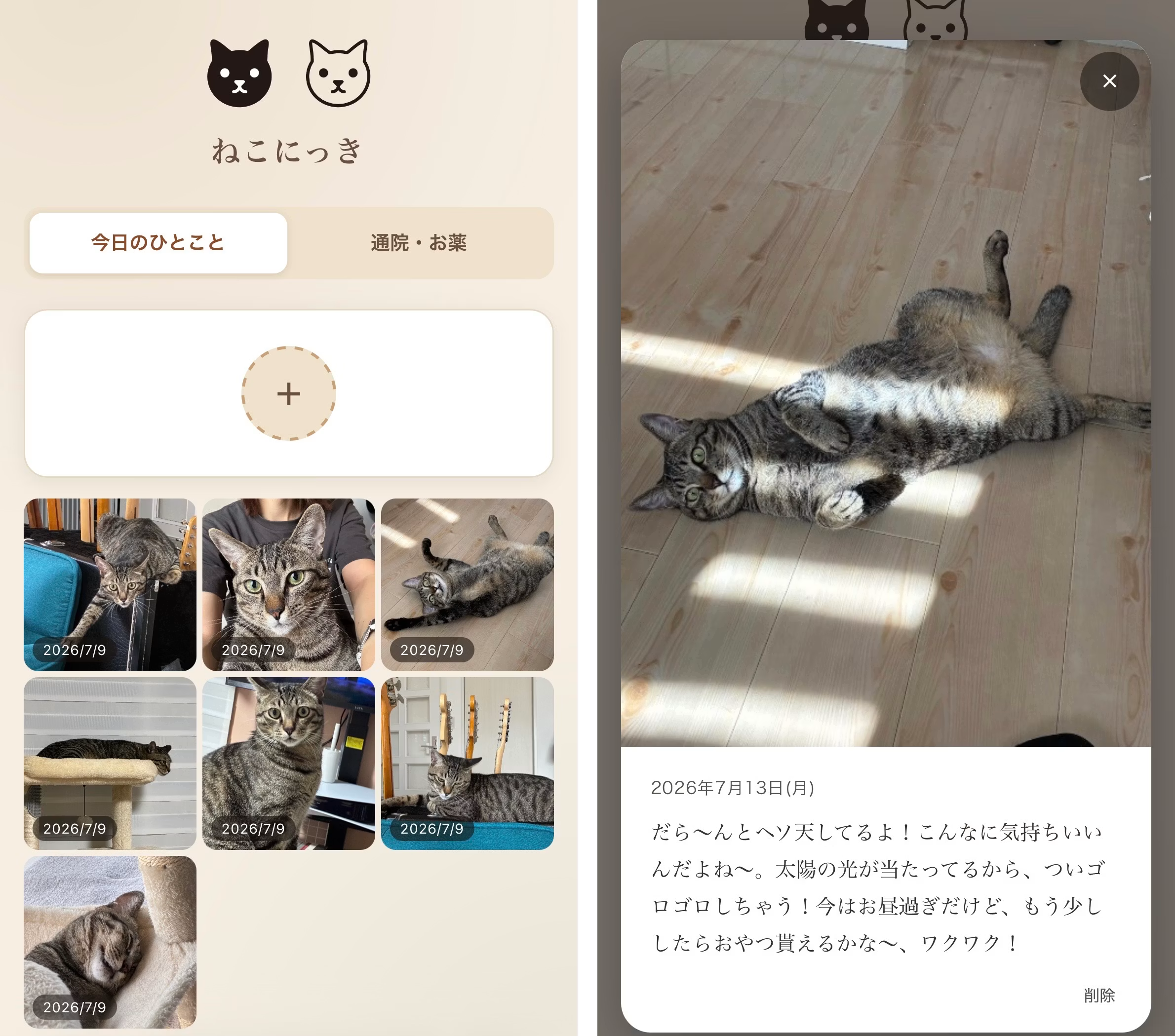
Following up on my previous story about creating a diff app for VSCode extensions using Claude Code, I also built a hobby project called a "cat diary."
While the implementation itself used Claude Code, I leveraged Groq (a service that was recently in the news), so I'd like to introduce that as well.
Background: Why I Started Using the Groq API
App Overview
Simply uploading cat photos and organizing them into folders seemed boring, so I thought it would be fun if an AI could view the uploaded photos and generate comments from the cat's perspective. I quickly implemented this idea.
I input the cat's profile, personality, and favorite things in advance. Through the prompt, I instruct the AI to always write from the cat's first-person perspective, expressing their feelings and actions in real time.
When you upload a photo, it generates a 100–160 character comment (2–3 sentences) from the cat's point of view.
Free LLM API: Groq
Comment generation requires an AI API.
That's where Groq came in—an API service that supports images and offers a free tier, using the Scout model from the Llama 4 model series.
Official website: Groq
Groq does not create AI models like ChatGPT or Gemini. Instead, it operates a service that runs open AI models published by other companies—such as Meta's free "Llama"—on its own high-speed chips.
The basic usage tier is completely free without credit card registration. We were able to register, issue an API key, and integrate it directly into our app.
(It is currently free, but please note that usage terms may change in the future.)
Although Groq was founded in 2016, it gained attention around 2023–2024 for its business of "dedicated chips that run AI inference at ultra-high speed," making it a relatively new trend.
We tried Groq!
According to specifications, it can process over 100 tokens per second, and it can generate responses at roughly 20 times the speed of ChatGPT.
We asked Groq chat: "Explain what a cat is in 1,000 words."
Video transcript (Japanese)
(Groq chatに「猫という生き物について1000字で解説して」と入力)
(質問を受け取ってから即時回答が生成される)
The time from receiving the question to completing the response was 1.91 seconds!
Insanely fast!!
Not only is it fast, but compared to traditional GPUs, it has also achieved a significant reduction in power consumption.
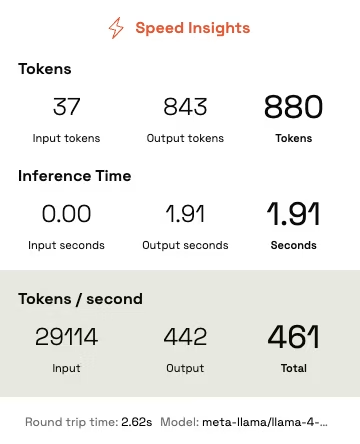
When I tested it, it generated a 843-token response (equivalent to several hundred characters in Japanese) in just 1.91 seconds (442 tokens per second).
Leverage lightning-fast API
Ideal use cases
- Applications where response speed is critical — Groq's greatest strength (dedicated LPU chip) is generation speed, making it well-suited for chatbots and real-time UIs (instant responses while typing, or voice assistants where timing is essential).
- Handling high volumes of simple tasks — For use cases like summarization, categorization, and basic text generation where you want to keep per-request costs low and process large quantities.
- Prototyping, personal projects, and internal tools — Like this app, when you want to test ideas for free first before committing.
Less suitable scenarios
- Production services requiring nuanced Japanese expression and complex instruction handling — The first-prompt instructions for first-person perspective didn't always come through clearly, and Claude and ChatGPT are more consistent with detailed prompt reproduction. That said, Japanese support has improved significantly.
- Commercial services requiring stable operation — The free tier has rate limits, and models are deprecated or changed relatively frequently (in fact,
llama-3.2-11b-vision-previewwas discontinued partway through), making it less suitable for core production features.
Summary
Groq is a service with a clear competitive advantage: lightning-fast generation speed.
Because of this, the convenience of "free-to-use AI API" means you can integrate it into an app on the very day you think of it—a huge boost for personal projects and proof-of-concept work. Plus, the hesitation of "paying for it might be too much..." disappears.
Combine Groq's strengths with Claude Code's ability to
"turn an idea into a prototype on the spot and polish it into a responsive experience all at once"
, and you get remarkably fast app development that anyone can pull off solo!!



I focus on frontend development with markup, JavaScript, React, and Next.js. I'm always happy when a site I've worked on goes live successfully! My hobbies are playing guitar, and I love cats and roasted sweet potatoes 🐱🍠
Hiraicchi
Frontend Engineer / Joined 2022