

Liberogic is a member of the International Association of Accessibility Professionals (IAAP) and employs staff who hold the highly specialized qualification "WAS (Web Accessibility Specialist)." With solid knowledge and skills based on international standards as its strengths, Liberogic is a leader in providing high-quality accessibility support, and regularly conducts employee training.
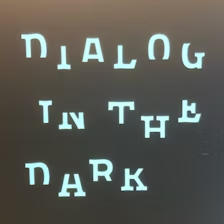
As part of this, I participated in "Dialogue in Silence," which allowed me to experience the world of the hearing impaired. This was my second visit to the Dialogue Diversity Museum, following "Dialogue in the Dark," which allowed me to experience the world of the visually impaired.
Click here to see the training at Dialogue in the Dark
■What is Dialogue in Silence?
Dialogue in Silence is entertainment that allows you to enjoy dialogue that transcends language barriers in a soundless world.
The experience is guided by a hearing-impaired attendant, an expert at communicating without relying on sound. Participants wear sound-blocking headsets. In the silence, they improve their concentration, observation skills, and expressiveness, and experience a sense of liberating freedom.
They will also discover ways to communicate with each other without making sounds or using their body language, and even if they speak different languages, they will be able to communicate more deeply than they could have ever imagined.
Since its launch in Germany in 1998, it has also been held in France, Israel, Mexico, Turkey, China, and other countries. Over one million people have experienced it worldwide, and in Japan, approximately 24,000 people have experienced it since its first event in 2017.
Quoted from the official Dialogue in Silence websitehttps://dis.dialogue.or.jp/
Once you've checked in, you'll be told that you can't make noise in the experience area and that you can't bring anything into the area, including your luggage, smartphone, or even your watch or accessories.
In order to create a completely silent space, the experience began with letting go of everything. The other participants looked a little nervous, not knowing what was going to happen next. I'm sure I looked the same.
Led by a hearing-impaired attendant, participants put on sound-blocking headsets and toured several rooms. Each room had a different theme, and participants had to complete tasks using designated communication methods (hand signals, gestures, facial expressions, simple sign language, etc.) while communicating silently.
Other than a one-line theme posted in the room, there are mysterious props and stage equipment, but it's no exaggeration to say that there is no information at all. You need to carefully observe the attendant and be able to decipher what kind of task they are trying to give you and what you need to do to complete it.
My feeling that "this might be surprisingly easy" was short-lived. Perhaps because I'm used to communicating through voice and text, there were times when I struggled with how to convey my message, and it took more brainpower than I had expected.

At the end of the experience, the headsets were removed and verbal communication was permitted, with the group sharing their impressions, including writing. When asked, "What did you think of the soundless world?" I answered without thinking, "It was lively."
Because there was no sound, everyone's facial expressions became more expressive than usual and their gestures naturally became more expansive as they tried to convey their thoughts.
Even though it was a quiet space, I felt a strong energy.
"If you have the desire to communicate and the other person is willing to understand, you can get the gist of it across properly." This feeling is similar to the experience of desperately trying to communicate using body language overseas when you don't speak the language.
On the other hand, there were times when the older people and elementary school children who were participating in the same session felt frustrated because body language alone was not enough to communicate effectively, perhaps due to differences in perception due to age. Including these points, it was a very thought-provoking experience and I learned a lot.
We want to create a society where no one is left behind, based on the premise that there are people with a variety of backgrounds, including disabilities, languages, and ages. To that end, at Liberogic, we will continue to learn about accessibility and apply what we learn to our actual production and implementation.
*In this article, we use the term "disabled person." If we use the term "disabled person," screen readers (screen reading software) used by visually impaired people may read it as "sawarigaisha." We hope you understand.



Started working as a professional writer at the age of 15. Though she was supposed to be juggling entertainment and writing, she soon became known as someone who loves saunas and cats. She holds first-class and advanced psychological counseling qualifications.
Ai-san
Creative Director / Scriptwriter / Executive Officer of Nekoana Inc. / ENTJ, Cool Winter Skin, Bone Stone