
At Liberogic, we're working to make our own site more readable for AI agents and LLMs.
It's becoming routine for LLMs and AI agents like Claude, Gemini, and ChatGPT—not just search engines—to read websites and help users by organizing information, making comparisons, and conducting research on their behalf.
At Liberogic's site, we're preparing for AI readability through robots.txt, sitemaps, Link headers, llms.txt, and generating Markdown files for each article.
This time, we're writing about Cloudflare's "Is Your Site Agent-Ready?" that they published two weeks ago.
Checking as a Content Site
Liberogic's site is a corporate and content site featuring company information, service descriptions, news, columns, and case studies. It's not an e-commerce site, nor is it an OAuth-authenticated API application.
Therefore, when checking, we selected the site type as "Content Site."
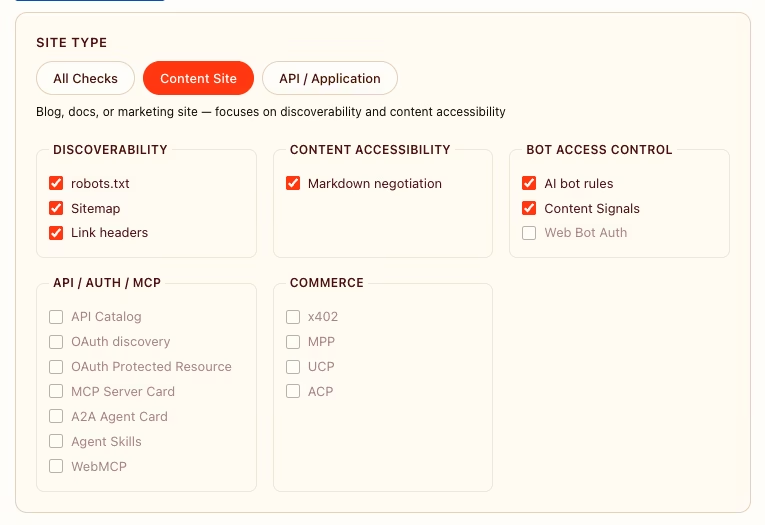
We excluded Commerce, API / Auth / MCP-related items from this evaluation and primarily verified the following aspects.
- Discoverability
- Content Accessibility
- Bot Access Control
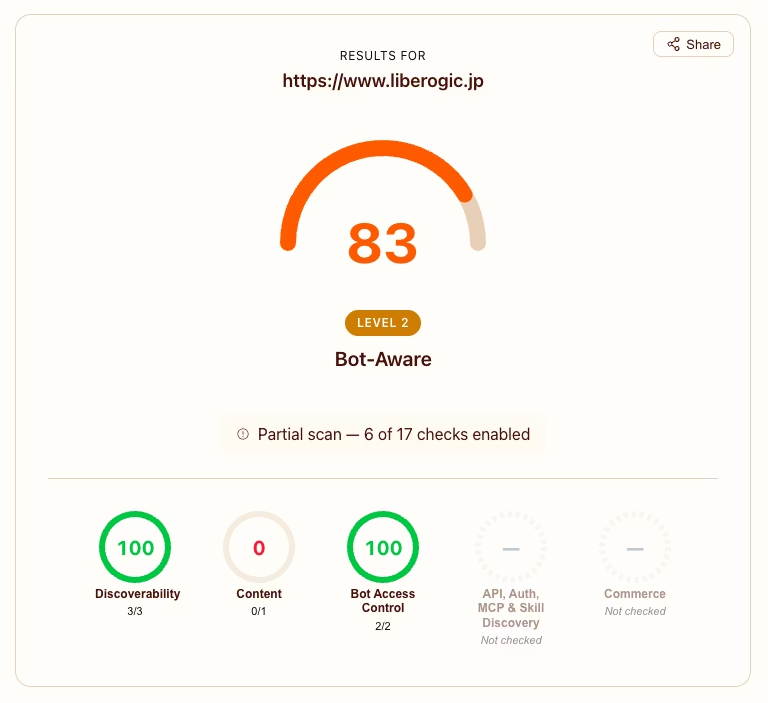
As a result......the score came out as 83 points, Level 2 "Bot-Aware" 😭
Why isn't it 100 points!!
Try it now / Verify
In this evaluation, we achieved 100 points for Discoverability and also 100 points for Bot Access Control.
We successfully implemented items such as robots.txt, sitemap, Link headers, AI bot rules, and Content Signals, and have established the fundamental mechanisms for AI bots to discover your site and understand your access policies.
In brief,
- Getting your site discovered
- Communicating where your content is located
- Defining your access policy for bots
- Emit signals for AI consumption.
Those areas have been addressed.
On the other hand, the Content Accessibility score came in at 0 (TT)
Looking at this alone might suggest "Wait, can't the content be read?", but the reality is a bit different.
Markdown content itself is already prepared.
At Liberogic, we already generate article content and case studies in Markdown format—a format that AI can easily read—at a certain proportion.
Both articles and case studies have proper Markdown files, link tags pointing to Markdown versions are set in the head of each page, and we've created a pathway for actual AI agents to discover these Markdown files.
It's not that we don't support Markdown; we structure content so that LLMs can retrieve the body text in a readable format. We're not in a state of "not being ready to serve content to AI."
So why didn't we get 100 points? 👺
The reason we didn't score 100 is not because we haven't done anything on our side, but because of compatibility between our current implementation setup and the checking tool's assessment specifications.
Liberogic's site is built with Astro's SSG and uses a hybrid approach with SSR on preview pages.
Content negotiation for Markdown is typically handled in middleware, but because we use a Cloudflare adapter for our hybrid setup, the output _worker.js takes precedence. This means middleware isn't loaded, and the checking tool doesn't recognize Markdown content negotiation.
In reality, Markdown files exist and are reachable via link tags in the head, but from the checking tool's perspective, it still reports "Markdown content negotiation not detected!"
Damn it! Making half-baked implementations!
…That's what you want to say, but of course we rely on Cloudflare every day.
Thank you for approving our partner certification.
But after consistently scoring 100 on Lighthouse, this is a bit frustrating.
Getting to 100 is possible! But we don't want to sacrifice operational efficiency just for the score, and we don't want to spend extra budget.
There are several approaches we could take.
- Set up a separate Cloudflare Workers instance to handle Markdown response
- Convert preview pages to CSR and move toward a fully static (SSG) setup
- Upgrade Cloudflare's service plan to the Business plan and rewrite URLs using Transform Rules
is one such approach.
Exactly. If we upgrade Cloudflare's service to the next tier, we could get the checker tool's score closer to 100.
But at this point, it's a bit questionable whether we should pay extra just for that!
Our real goal isn't to achieve a perfect score on the checker tool, but to ensure that AI agents and LLMs can properly read the information on Liberogic's site. From the perspective of LLMs reading content, we believe we've already made significant progress on the necessary measures.
It's more important that content is readable than to increase costs just to reach 100 points.
It's important that we can maintain it properly.
At Liberogic, we want to maintain that balance.
Don't forget llms.txt!
While not included in this round of checks, Liberogic also supports /llms.txt.
llms.txt is a table-of-contents-like file that tells LLMs "what information does this site have and which pages should you read?"
Similar to how search engines use sitemap.xml, this serves to organize site overviews and navigation to important content—but specifically tailored for LLMs.
While not included in the checker's inspection items, Cloudflare likely emphasizes data quality—specifically how well content (body text) can be extracted with minimal noise and whether it's converted to Markdown—and may have deliberately excluded it for this reason.
Can't we just feed the HTML as-is?
When having an AI agent read a website, you can certainly have it parse the HTML directly.
However, real web pages contain a lot of non-content information—navigation, headers, footers, decorative elements, JavaScript controls—and even visually clean pages often become noisy for LLMs.
When you force complex HTML into Markdown conversion, heading structures, lists, and intended meaning can collapse, ultimately creating data that's harder for LLMs to read.
This will probably improve along with AI advancements soon enough, but we believe what matters now is tackling one thing at a time. How far along is your site in these preparations??



A CEO who always acts as a true counterpart. Someone who loves understanding new technologies, finds joy in those moments when something becomes more convenient, and is a hands-on person who dives deep into projects. Excited about the technologies of tomorrow, enjoying new experiences at every stage of life.
Tadanori Morimoto
Project Manager / Director / Founded in 2007