
In Japan, web accessibility services are not yet considered mandatory. That said, awareness of their importance has grown significantly in recent years.
As you may know, the Act on Elimination of Discrimination Against Persons with Disabilities was amended in April 2024, making "reasonable accommodation for people with disabilities" mandatory for private businesses as well. While this law does not establish specific standards or obligations in concrete terms, a trend of "accommodation is the norm" is strengthening across society, regardless of whether penalties apply.
Accessibility is not something special, but rather a natural effort to reach more people with your services.
So what is the awareness and adoption of accessibility like overseas?
Comparing representative countries—the United States, EU, and Canada—reveals clear differences from Japan's situation.
Web accessibility in Japan
Japan's web accessibility compliance is primarily based on JIS X 8341-3:2016. This standard was developed with reference to WCAG 2.0, and future JIS revisions are moving toward adoption aligned with WCAG 2.2.
The Ministry of Internal Affairs and Communications provides a checking tool called miChecker to support compliance with this JIS (WCAG 2.0).
miChecker is an accessibility diagnostic tool that automatically checks the parts that can be judged mechanically. However, there are many items that cannot be covered, and while final human judgment is ultimately necessary, this step is often overlooked.
Additionally, "reasonable accommodations" under the Act on Eliminating Discrimination Against Persons with Disabilities is a major legal pillar, but regarding web accessibility, there are no specific standards or compliance obligations clearly stipulated in law, and disclosure of compliance status is not mandated. This creates a stark contrast with overseas approaches like those in the United States and EU, which have clear legal obligations and disclosure systems.
In Japan, the format for reporting is also discretionary. There is a VPAT (Voluntary Product Accessibility Template) inspired Information Accessibility Self-Assessment Format (Japan Version VPAT), which is commonly used in the United States, but it is not yet widely adopted.
Web Accessibility in the United States
In the United States, accessibility compliance is mandated under Section 508 of the Rehabilitation Act, which requires federal agencies to ensure accessible information and communication technology (ICT) when procuring it.
The standard requires WCAG 2.0 AA compliance, and compliance with WCAG 2.1 AA is recommended.
In the private sector, web accessibility is actively pursued due to the high risk of litigation based on the Americans with Disabilities Act (ADA).
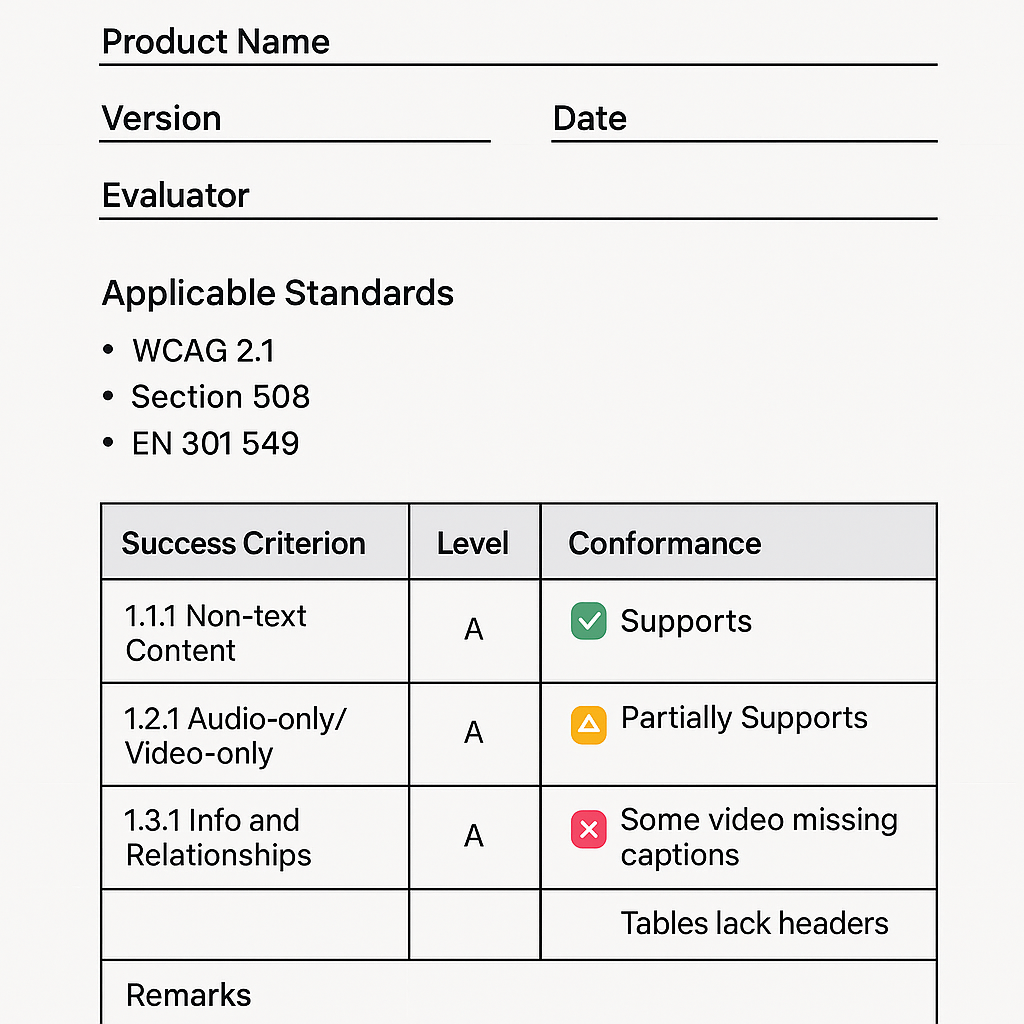
Many companies use VPAT (Voluntary Product Accessibility Template) to create ACR (Accessibility Conformance Report) demonstrating accessibility compliance status in order to avoid litigation risks. In the VPAT, each success criterion is evaluated with categories such as Supports, Partially Supports, Does Not Support, Not Applicable, or Not Evaluated, reasons are documented in detail, and the results are compiled and published as an ACR.
While leveraging automated testing tools such as axe-core and WAVE, final judgment and detailed evaluation are prioritized as human tasks.
This approach stands in contrast to Japan's focus on mechanical checking.
Web Accessibility in the EU
In the EU, based on the Web Accessibility Directive (EU Web Accessibility Directive),
EN 301 549—a technical standard—is central to requirements, with WCAG 2.1 AA compliance mandated for public sector websites and mobile applications. A key characteristic is the requirement to publish an Accessibility Statement.
This statement is an expanded version of what Japan calls an accessibility policy. It must include detailed descriptions of the site's accessibility status, non-compliant areas, and alternative means. Organizations must also provide a feedback mechanism for users to report issues.
The major difference is that while Japan's accessibility policy typically publishes test results, the EU's Accessibility Statement goes further by emphasizing a system where users can directly report problems.
From items deemed non-compliant under WCAG standards, particularly significant and high-impact non-conformities are highlighted, with clear explanations of the reasons and future improvement plans provided.
Additionally, the European Accessibility Act (EAA) came into force in June 2025. This law imposes accessibility obligations not only on the public sector but also on specific private companies operating in the EU market. E-commerce sites, banking services, e-books, and passenger transport services are among the targets, and their websites and apps must meet WCAG 2.1 AA. Organizations must prepare a EU Declaration of Conformity—a document demonstrating compliance with the EAA.
Web accessibility in Canada
The federal law ACA (Accessible Canada Act, 2019), enacted in 2019, establishes the main framework for web accessibility. A distinctive feature is that this law, similar to the EU's Web Accessibility Directive, references EN 301 549 as its technical standard.
Under the ACA, government agencies and certain private enterprises (banks, telecommunications, public transportation, etc.) are required to develop an organization-wide accessibility policy and submit progress periodically as an Accessibility Compliance Report to the government.
While publishing this report for users is not mandatory, in practice it is often disclosed as an Accessibility Statement, with the web portion summarized to show WCAG 2.1 AA achievement.
Separate from federal law, some provinces like AODA (Accessibility for Ontarians with Disabilities Act) in Ontario have their own provincial requirements. AODA requires public sector organizations and large private businesses to comply with WCAG 2.0 AA (WCAG 2.1 AA compliance is recommended), and requires large organizations to develop and publish an Accessibility Compliance Report and Multi-Year Accessibility Plan.
In Ontario, there is a tendency to emphasize not only automated testing tools but also usability testing conducted by users with actual disabilities. Educational institutions such as the University of Toronto provide practical guidelines for developers, aiming to improve accessibility based on more realistic user experience.
Summary
Compared to leading countries in web accessibility, Japan's approach to web accessibility compliance still has a strong emphasis on "efforts" and "voluntary" measures.
However, with the revision of the Disability Discrimination Law and growing societal awareness, there is considerable potential for more concrete mandates and disclosure systems to be established in the future.
While tackling accessibility as a task is important, accessibility compliance is ultimately a natural effort to reach more people with your services.
By making progress on accessibility step by step from now on, you'll be able to adapt smoothly to future changes, and it can become a reason for users to choose your site as one they can trust and use with confidence.
Rather than "doing it because it's mandatory," adopt the mindset of "doing it because we want to reach more people."
This kind of forward-thinking approach to accessibility is becoming increasingly important!
Liberogic's accessibility audit service
Liberogic provides an accessibility audit service.
The key strength of this service is that we conduct specialized audits aimed at compliance with international standards.
Rather than using miChecker, we work from our own custom checklist that covers WCAG 2.0 A through WCAG 2.2 AAA. We leverage tools like axe-core while also thoroughly examining areas that require human judgment, providing detailed diagnostics from issue identification through specific remediation methods.
Our service also supports the VPAT format, allowing us to provide an Accessibility Conformance Report (ACR) alongside an inspection certificate.
Of course, beyond auditing, we also offer accessible website design and development that maintains creative quality.
As a member of the IAAP (International Association of Accessibility Professionals), Liberogic supports the realization of genuine accessibility that goes beyond mere formal compliance.


A "master of technique" who jumped from DTP into the web world and, before he knew it, mastered markup, frontend, direction, and accessibility. Active across multiple domains since Liberogic's early days, he's now a walking encyclopedia within the company. Recently, he's been diving deep into prompt-driven efficiency optimization, wondering "Can we rely more on AI for accessibility compliance?" Both his technology and thinking continue to evolve.
Ayumu Futamata
IAAP Certified Web Accessibility Specialist (WAS) / Markup Engineer / Frontend Engineer / Web Director